 ACPP
ACPP
ACPP / FAQ
Straight answers,
including the awkward ones.
Questions buyers actually ask before they switch supplier — including the two most manufacturers would rather you skipped.
 BPI Certified
What it is made of, and who verified it
Materials & certification
Are ACPP cups BPI certified?
Yes. We are a member of the Biodegradable Products Institute and we hold the certification — those are two different things, and plenty of suppliers hold only the first. Our certified SKUs are listed in BPI’s public online directory under American Choice Paper Products, so any buyer, inspector or composter can verify it independently without contacting us.
Are ACPP products biodegradable?
They are certified commercially compostable, which is a narrower and more useful claim. We avoid using “biodegradable” on its own because on its own it implies the item returns to nature within a year of however you throw it away — and in a sealed landfill, no material does that reliably.
What we will tell you instead is the material, the lining and the disposal route where it works: BPI certified against ASTM D6400 / D6868, designed for commercial composting facilities.
Is there a plastic lining inside the cups?
There is no polyethylene lining. The moisture barrier is PLA — a polymer derived from plants that is certified to break down with the cup in a commercial composting facility, rather than surviving the paper and staying behind as plastic film.
We name the board, the lining and the inks in writing before you order, in a form you can hand to a labelling reviewer.
Will they compost in a backyard pile?
Partially, and slowly. Home piles do not hold the temperature a commercial facility does. Thin items go first; heavier board and the PLA lining take much longer and may not finish.
BPI certification covers industrial composting only. If your customers ask, the honest answer is “commercial composting, if your city has it” — and that is the answer we would rather you gave.
Do paper straws contain PFAS?
Many do. A 2023 study by researchers at the University of Antwerp, published in Food Additives & Contaminants, tested straw brands sold in Belgium and found PFAS in 18 of 20 paper-straw brands. Paper is not automatically the safe swap — what matters is what gets added to the fibre during manufacturing.
This is exactly why the fluorine limit inside BPI certification matters. Certification requires the manufacturer to declare no added fluorinated chemicals and to test total organic fluorine under 100 ppm. Above that, a product is disqualified. So the PFAS question is answered by the same third party that verifies compostability.
Three words that appear on every competing box
How to read a label
What does “biodegradable” actually mean?
What it should mean: the entire item breaks down and returns to nature within one year of normal disposal. That is the bar U.S. regulators use for an unqualified claim.
What it usually means: the material could break down somewhere, under conditions the label never names. If a brand will not say where, assume nowhere.
What does “eco-friendly” mean?
Nothing specific. It is a general benefit claim, and general benefit claims are the hardest thing in this category to substantiate. BPI’s own labelling rules prohibit printing it on certified packaging without showing the explicit certificate.
What to ask instead: friendly compared to what, measured how, verified by whom. Three questions. Most suppliers cannot answer the second one.
Is “plant-based” the same as compostable?
No. Plant-based describes where a material came from; compostable describes where it can go. PLA is plant-derived — and it is still a polymer.
The claim that carries weight is the second one, because it has a test behind it. A plant-derived lining that has not been certified against ASTM D6400 or D6868 tells your customer nothing about what happens after the last sip.
Who is liable if a claim on my packaging is wrong?
You are. Under the FTC Green Guides, the business displaying the environmental claim carries the legal liability — not the manufacturing plant that supplied the stock.
That is why we hand you written guarantees setting out exactly which claims our stock can support, along with the certificate behind them. It costs us nothing and it is the single most useful thing a manufacturer in this category can give a buyer.
Volumes, print and territories
Ordering & distribution
Can we print our logo?
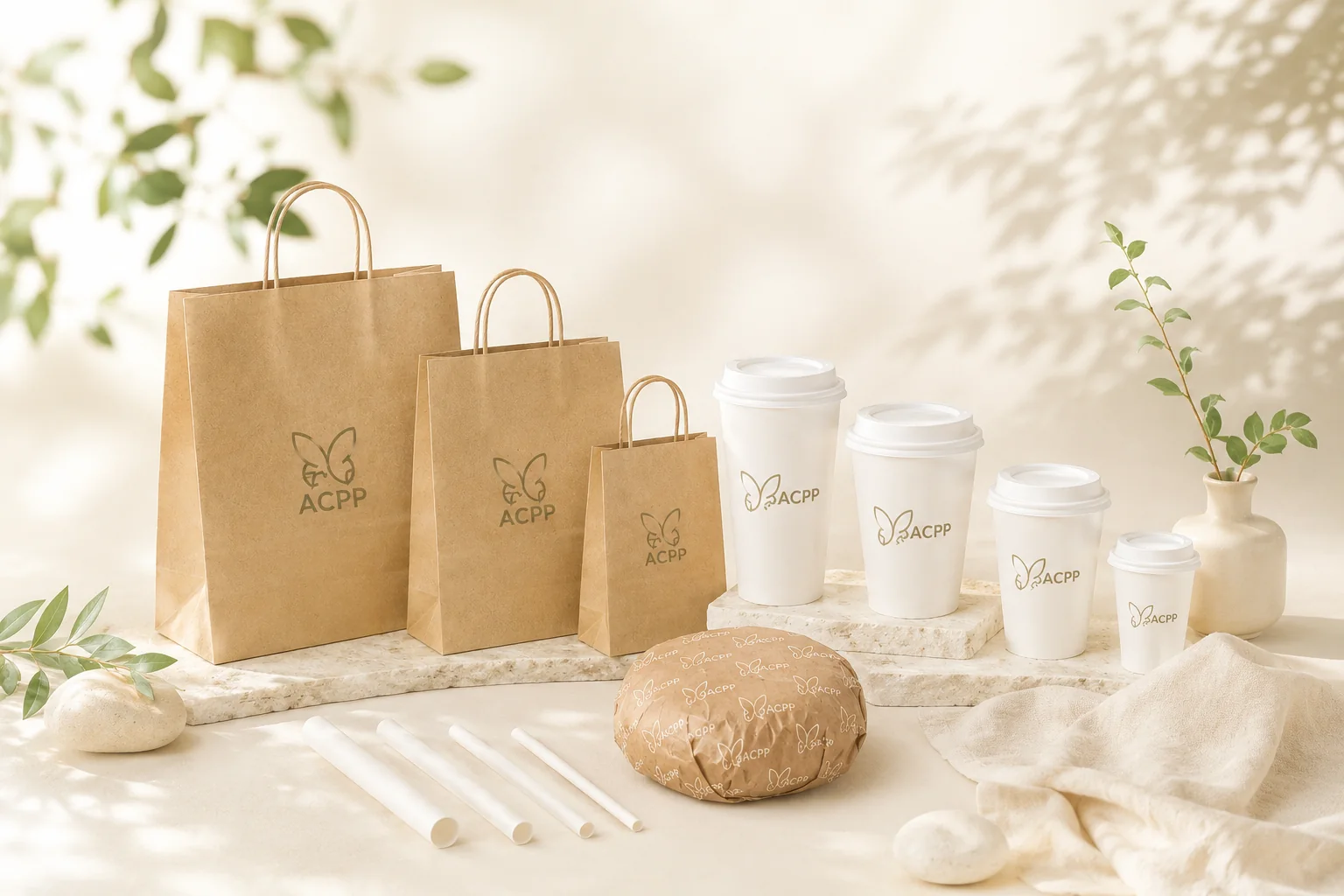
Yes, on all four lines — cups, straw wrappers, carry bags and wrapping paper. Custom print carries its own lead time and minimum, so most accounts start on blank stock and switch to printed on the second order once artwork is approved.
How does distribution work?
We work with distributors by territory. You get tiered per-case pricing, the full spec sheet library, and the option to sell under your own print. Tell us the states you cover in the contact form.
Why the switch is happening now
The deadline is
somebody else’s calendar.
Switching on a compliance date always costs more than switching on your own schedule, because you lose the ability to negotiate.
12
states now ban single-use plastic bags.
The regulation is not coming — it arrived. If you operate across state lines, your packaging list is already two lists.
Earth911, state of U.S. plastic bans, February 20267
states make producers pay for packaging waste.
Extended producer responsibility laws move disposal cost back up the chain. What you put in a customer’s hand becomes a line on someone’s balance sheet.
Earth911, February 20269%
of all plastic ever made has been recycled.
The other 91% is in landfills, waterways, or broken into microplastics. “Recyclable” on a label and recycled in practice are not the same number.
Earth911, February 2026Talk to us
Still have a question? Ask it directly.
If it is about materials, certification or claim wording, we will answer in writing. We reply within 48 hours.